Daily Restaurant Operations: What Has to Happen Every Day
The daily restaurant operating rhythm: open, prep, service, close, money, people, and food. A floor-level guide for owners and GMs running the room.
- Published
- 2026-08-25
- Last Updated
- 2026-08-25
Disclosure
This article is written from firsthand operating experience at Jeju Snow Salmon, a restaurant operated by the team building WhateverAsk, and from the same floor-level work independent owners and GMs do every day. It is an operating page for other restaurant operators. It is not a product pitch, not a legal or health-code manual, and not a claim about WhateverAsk traffic or search performance.
NeuroPOS appears only if a workflow we actually ran is used as a case. It is not the subject of this page. Observations about daily rhythm are owner / operator observations, not audited time studies and not invented percentages.
Local labor, food-safety, cash, and employment rules vary. Confirm requirements with your local health and labor authorities before you turn any of this into policy.
Quick Answer
Daily restaurant operations are not a theory of “how restaurants work.” They are the work that has to happen today, in order, so tonight’s guests get a room that is ready and tomorrow’s team does not inherit a mess.
If you are the owner or GM who is actually on the floor, the useful question is not “what is restaurant operations?” The useful question is: what has to happen every day, who owns it, and what breaks if it does not?
Name the day as a Daily Operating Rhythm with seven lanes:
- Open: the building and the team can receive the first guest
- Prep: food and stations are ready for the volume you actually expect
- Service: tickets, hospitality, and recovery stay owned during the rush
- Close: tonight resets tomorrow instead of charging it interest
- Money: cash, cards, voids, comps, and a simple daily read exist
- People: coverage, lateness, coaching, and handover are named, not hoped
- Food: receiving, temps, 86s, waste, and quality at the pass have an owner
Most independents already do pieces of this. The failure is not effort. The failure is an unnamed day: open belongs to whoever arrived first, prep belongs to whoever is anxious, service belongs to whoever shouts, close belongs to whoever stayed last, and money, people, and food get a glance if the owner is not exhausted.
This page is the daily rhythm. Written procedures, training paths, and handbooks matter. Dedicated guides for those systems are not live yet in this operations lane. Do not wait for a binder to start naming what today requires.
Who this page is for
This is for the independent owner, operating partner, or GM who is running the floor this week. You take the call-out. You walk the line. You count the drawer, or you stand next to the person who does. You already know the room. You do not need a classroom definition of restaurant operations.
It is also useful for F&B directors and consultants who have to tell a founder, calmly, that the restaurant does not have a daily system. It has a daily hero.
It is not written for guests, diners, or “food lovers.” If you are choosing where to eat tonight, this page will not help you.
The owner who became the system
A lot of independents confuse working hard in the restaurant with running daily operations.
Working hard looks like this: you unlock, you fire the line, you run food, you greet regulars, you fix the printer, you close the drawer, you text two people about tomorrow, and you fall asleep still replaying table nine.
That can keep a small room alive. It is not a day system. It is you.
The day system is what still happens when you are late, when a cook calls out, or when a good Saturday makes you believe the restaurant is “fine.” Guests do not experience your intention. They experience whether open, prep, service, close, money, people, and food were owned before they sat down.
At Jeju Snow Salmon we learned this the unromantic way. Opening energy is a project. A normal Tuesday is a ritual. The restaurant got calmer on the days we named the ritual. It got louder on the days we trusted memory.
If you want the longer founder arc behind that shift, from opening fear to systems thinking, read The Operator Journey: What Running a Restaurant Actually Changes. This page stays on the day itself.
What “daily restaurant operations” actually means
Search the phrase and you will find two kinds of pages.
One kind lists departments: kitchen, front of house, purchasing, HR. That is an org chart. Useful in a chain. Vague on a Tuesday at 3:40 p.m. when the dining room is about to turn and the walk-in door is still open.
The other kind promises a complete manual: SOPs, handbooks, training tracks, opening binders. Those systems matter. They are how a day becomes teachable. They are not live as dedicated guides in this operations lane yet, and they are not what this page is. A binder you do not run is not daily operations. It is storage.
Daily restaurant operations means: the repeating work that must finish today so service can be honest tonight and the next shift can start without a forensic investigation.
Day to day restaurant operations are the same seven lanes, executed by whoever is actually on the schedule, not by a document that lives in a folder.
If you only remember one sentence: the day has a rhythm, or the owner becomes the rhythm.
Original framework: the Daily Operating Rhythm
We name the pattern so you can audit a real shift without buying anything and without waiting for a future template pack.
The Daily Operating Rhythm has seven lanes. Service holds only if all seven move. A restaurant can cook well and still have a bad operating day if one lane is informal.
| Lane | Question it must answer before the next window | What “done” looks like | What a miss looks like to the guest |
|---|---|---|---|
| 1. Open | Can we receive the first guest without a scramble? | Doors, lights, stations, restrooms, menu truth, briefing, first-shift people present | A dark dining room, a missing menu item nobody mentioned, a host who is still setting tables |
| 2. Prep | Is the line ready for the volume we actually expect? | Mise, batch, thaw, 86 board, allergen notes, station photos if you use them | Mid-service “we’re out,” panic prep, a cook leaving the line to find a backup |
| 3. Service | Is every live ticket seen, sequenced, and owned? | Capture, kitchen visibility, hospitality, recovery, mid-shift reset | Waiting, wrong pace, apologies that start before the food |
| 4. Close | Does tomorrow inherit a reset, or a debt? | Food stored, stations reset, trash, cash, notes, who locks | Slow open, missing mise, a mystery smell, a drawer that does not match memory |
| 5. Money | Do we know what today did, without waiting for month-end? | Drawer, cards, voids, comps, paid-outs, a one-line daily read | “We were busy” with a thin envelope; disputes you cannot reconstruct |
| 6. People | Who is on, who is late, who is covering, who was coached? | Punch or paper truth, call-out plan, one correction that does not wait until Friday | A station with no owner; a new hire guessing; a lead who only hears problems after the rush |
| 7. Food | Is receiving, holding, waste, and the plate at the pass owned? | Deliveries checked, temps, 86s, waste noted, quality stop at pass | A soft product you should have refused; a dish that left because nobody had permission to stop it |
Two rules sit under the table:
- Every lane needs a name on today’s schedule. “Everyone” is not an owner.
- A lane that only lives in the owner’s head is not a lane. It is a dependency.
You do not need seven new meetings. You need seven named finishes.
How the seven lanes sit inside one operating day
Think of the day as four time windows and three standing accounts.
| Window or account | Lanes that dominate | Typical failure if unnamed |
|---|---|---|
| Pre-service | Open + Prep + People | First guests arrive while the team is still assembling the restaurant |
| Service | Service + Food + People | Tickets stack, quality slips, coverage holes get filled by the owner |
| Close | Close + Money + Food | Tomorrow pays for tonight’s shortcuts |
| Standing accounts (all day) | Money + People + Food | The room can feel fine while waste, labor, or cash quietly go wrong |
The standing accounts are why a busy night can still be a bad operating day. Covers and compliments live in Service. Contribution, waste, and labor live in Money, Food, and People. If those three are informal, the floor will lie to you politely.
Lane 1: Open. The restaurant has to exist before the guest does
Open is not “unlock and hope.” Open is the conversion of a dark room into a place that can take money and deliver a promise.
A usable open answers four questions:
- Building. Lights, HVAC, restrooms, music, doors, cleanliness a guest will notice in the first ten seconds.
- Station. FOH and BOH set to the same map you will run tonight, not last Saturday’s leftover layout.
- Truth. 86 board, menu, hours, and any “we are out of” facts match what the guest will be told.
- People. The people on the first shift are present, briefed, and know who is lead.
The pre-shift briefing does not need to be a speech. It needs four facts: who is lead, what is 86, what the first rush risk is, and one standard you will protect today (ticket entry, greeting, allergen stop, pass check). If the briefing is a vibe, it will lose to the first ticket.
Owner tell: if you cannot leave the first thirty minutes without the room stalling, you do not have an open. You have an owner-shaped open.
Lane 2: Prep. Cook for the day you will have, not the day you fear
Prep is where a lot of independents hide anxiety. Over-prep “just in case.” Under-prep because yesterday was quiet. Both are daily operations failures. One wastes food and labor. The other dumps panic onto service.
Prep has to be tied to a real expectation: reservations if you take them, the daypart you usually get, known events, weather, and what is already in the walk-in. A prep list that ignores the walk-in is a shopping list, not operations.
Minimum daily prep truth:
- What must be ready before doors
- What can be batched later without hurting the first rush
- What is already prepped and should not be remade
- What is short, and who is allowed to 86 it
If a cook has to invent the list from memory every morning, you do not have prep. You have a talented person absorbing uncertainty.
Import-cost pressure is part of this lane for many independents, especially rooms that rely on imported protein or specialty goods. That is operator-market context, not a WhateverAsk statistic: when replacement product is slow or expensive, over-prep and quiet waste hurt more. The daily answer is not a motivational poster. It is a prep list that respects what you already hold.
Lane 3: Service. The day is won or lost in owned tickets
Service is hospitality plus information. Guests feel both.
Hospitality is human: greeting, pace, recovery, reading a table. Information is operational: the order was captured, the kitchen saw it, the pass checked it, the table received it.
Two companion pages already cover the information failures in detail:
- Wrong item, wrong modifier, wrong table: How AI and Restaurant Automation Can Prevent Wrong Orders
- Correct ticket that is late, buried, or never seen: Why Kitchen Tickets Still Get Lost
This page only needs the daily rule: during service, the shared ticket is the queue. Verbal relays are for hospitality notes (“table eight is celebrating”), not for which ticket is live.
Service also includes the mid-shift reset. Opening taught many of us fear. Operating taught us that the silent failure is the unfinished afternoon sitting under the dinner rush. Glasses, mise, restrooms, 86 board, expo surface, and a two-minute lead check between rushes are daily operations, not extra credit.
If you want the founder version of that mid-shift lesson, it sits inside The Operator Journey. The daily version is simpler: name the reset, or dinner inherits lunch.
Lane 4: Close. Tomorrow is a guest you have not met yet
Close is the most skipped lane in independent restaurants, because the people who would do it well are tired, and the people who would inspect it have already gone home in their heads.
A close that protects tomorrow has four finishes:
- Food. Stored, labeled, dated, and not left as a riddle for morning prep.
- Room. Stations reset, trash out, guest-facing surfaces honest.
- Money. Drawer counted, cards batched or recorded, paid-outs explained.
- Notes. What broke, what is 86, what the next open must know.
A close note can be five lines. “Fine” is not a note. “Walk-in door was left ajar; salmon pulled forward; two call-outs possible tomorrow” is a note.
Owner tell: if your morning personality is forensic investigator, last night’s close failed.
Lane 5: Money. The day has a number even if you hate looking at it
Daily money is not month-end accounting. It is a short, same-day read so the floor cannot gaslight the week.
At minimum, someone named today should be able to answer:
- Did the drawer match, or is there a variance we can explain?
- What did we void, and why?
- What did we comp, and why?
- Were there paid-outs, and for what?
- Does today *feel* busy in a way the tender and the ticket count also support?
You do not need a dashboard product to do this. A paper close sheet and a phone photo of the POS daily report are already a system if they happen every day.
What you must not do is invent a story from the dining room’s mood. A full room with heavy comps, heavy waste, or heavy labor can still be a weak operating day. The journal companion to this page is about that exact dissonance — *The Week the Floor and the Numbers Stopped Matching* (Package 2; link only after that page is live).
No dollar figures are published here. You already have yours. The operating rule is: read them the same day, not when the accountant is already disappointed.
Lane 6: People. The schedule is a promise, not a suggestion
Daily people operations are not “HR.” They are who is standing where, today.
The daily people list is short and unromantic:
- Who is supposed to be here
- Who is late or missing
- Who is covering, and which station is now thin
- Who needs one correction today (not a performance review, one correction)
- Who is lead, and who they hand to
Hiring pressure is market context, not a WhateverAsk metric: replacing a cook or a server often takes weeks, commonly in a four-to-eight-week band in many operator markets, and sometimes longer. That is why the daily people lane cannot wait for a perfect hire. The restaurant still has to run tonight with the people you have.
If coverage only works because you stay, you do not have a people system. You have an owner-shaped hole.
Handover belongs here. When leads change, the next person needs the 86 board, the money state, the guest issues still open, and the one thing that must not be forgotten. A verbal “you’re good” in a doorway is how mid-shift inheritance becomes dinner’s problem.
Lane 7: Food. The product is a daily operation, not a menu idea
Food as a daily lane is not recipe development. It is receiving, holding, cooking, stopping, and wasting on purpose instead of by accident.
Daily food ownership:
- Deliveries checked against what was ordered, not signed as a courtesy
- Temps and holding that match your local health floor
- 86s pushed to FOH before the guest hears them from a disappointed server
- Waste noted in a way you can read at the end of the week
- Permission at the pass to stop a plate that should not leave
Quality stops are daily operations. A pass that is afraid to send food back will send the problem to the table instead.
Waste is also daily operations. If waste is only a feeling (“we threw away a lot”), Food and Money cannot talk to each other. You do not need a corporate waste app. You need a named place to write what died and why: over-prep, no-show, cook error, spoilage, refused delivery.
Where the day breaks
Independent owners usually diagnose a bad day as a people problem or a volume problem. Those can be real. The quieter pattern is a broken lane.
| What you hear | Lane that is usually unnamed | What to inspect today |
|---|---|---|
| “We were just slammed.” | Service, sometimes Prep | Capture lag, ticket stacking, missing mid-shift reset |
| “Nobody showed up ready.” | Open + People | Briefing, first-shift presence, who is actually lead |
| “The food was there, it just took forever.” | Service | Shared ticket visibility and ownership (see the kitchen-tickets page) |
| “We got the order wrong.” | Service + Food | Structured capture and pass check (see the order-accuracy page) |
| “Morning was a disaster.” | Close from yesterday | Food storage, notes, drawer, station reset |
| “We were busy but it doesn’t feel like it.” | Money + Food + People | Voids, comps, waste, labor feel vs ticket count |
| “I can’t take a day off.” | All seven, owned by you | Which lane has no second name on the schedule |
The table is a diagnostic, not a personality test. If the same row repeats for two weeks, you do not have a motivation problem. You have an unnamed lane.
A working day versus a heroic day
It helps to see the difference in one view.
| Heroic day (common) | Working day (the aim) | |
|---|---|---|
| Open | Owner arrives first and builds the restaurant around themselves | Named opener runs a short list; owner can walk, not invent |
| Prep | Cooks guess from yesterday’s fear | List tied to walk-in + expected daypart |
| Service | Shout-outs, pocketed pads, owner expo | Shared ticket, named expo or lead, mid-shift reset |
| Close | Tired people leave a half-reset | Four finishes: food, room, money, notes |
| Money | “We’ll look on Monday.” | Same-day drawer + voids/comps + one-line read |
| People | Texts at 4 p.m.; owner covers the hole | Coverage plan, one correction, written handover |
| Food | Waste discovered as a smell | Waste noted; pass may stop a plate |
| Owner body | Required for the day to exist | Required for judgment, not for every lane |
Heroic days can still produce good food and warm reviews. That is why they last too long. The restaurant teaches the owner that intensity works. Then hiring takes weeks, someone gets sick, and the whole rhythm collapses because it was never a rhythm.
What you can see without inventing metrics
WhateverAsk does not publish restaurant performance statistics on this page, and you should not invent any to make your own day feel more scientific.
You can still see the day. Use operator signals, not vanity:
- Did open finish before the first guest, without you building the room alone?
- Did the first rush start with an 86 board that FOH already knew?
- Did tickets stay visible, or did people shout?
- Did a mid-shift reset happen, or did dinner inherit lunch?
- Did close leave a note a stranger could use?
- Did money get read the same day?
- Did one people issue get handled the same day it happened?
- Did waste get written down, even roughly?
If you want a weekly read on the emotional version of this, when the room feels successful and the week does not, use the journal companion once it is live.
Practical playbook: install the rhythm in seven days
You do not need a membership kit and you do not need to wait for SOP or handbook pages that are not live in this lane. You need names on this week’s schedule.
Day 1: Map yesterday, not the ideal restaurant
Write yesterday as it actually ran. For each of the seven lanes, write who did it, when it finished, and what was still informal. Be rude and specific. “Prep happened” is not a map. “Two cooks prepped from memory; no 86 board until 12:40” is a map.
Day 2: Name one owner per lane for the next three shifts
Put the names on the same paper you already use for the schedule. If you are the owner of more than three lanes, that is the finding. Do not “fix morale.” Add a second name or cut the menu of work.
Day 3: Fix Open or Close, not both
Pick the lane that is currently charging the other one interest. If mornings are forensic, fix Close. If first guests see a restaurant still being assembled, fix Open. Write a list that fits on one page. Inspect it once.
Day 4: Kill one informal service handoff
Choose one: pocketed pads, shout-only tickets, or a pass that runs on memory. Replace it with one shared record. The kitchen-tickets and order-accuracy pages are the deeper playbooks. Today you only need one handoff to die.
Day 5: Install a mid-shift reset
Two to eight minutes between rushes: restrooms, expo, 86, water/glass, one lead walk. Write what “reset” means in your room. Then do it on the next split shift.
Day 6: Same-day money and waste
Count the drawer. List voids and comps. Write waste in one column: item, reason, rough scale (pan / portion / case), not a fake dollar. Do this even on a good night, especially on a good night.
Day 7: Handover card
When leads change, four lines move: 86, open guest issues, money state, the one thing tomorrow must not discover the hard way. If you are the only person who can write those four lines, the people lane is still you.
After seven days you will not have a corporate ops department. You will have a named day. That is daily restaurant operations.
Founder insight
Before we opened Jeju Snow Salmon I worried about the menu, the room, and whether we would get the order right. I underestimated the ordinary day.
The ordinary day is where a restaurant becomes true or becomes theater. A beautiful Saturday can hide an unnamed close. A polite dining room can hide waste. A team that “knows what to do” can still leave the next shift a debt.
I also underestimated how much of my own identity was tied to being necessary. If I am the open, the expo, the closer, and the only person who knows the drawer, I can call that leadership. Operating taught me it is often just unnamed work wearing a founder’s name.
NeuroPOS was a tool in some of our workflows. It is not the lesson. The lesson is the rhythm: open, prep, service, close, money, people, food. If those are named, tools can help. If they are not named, tools record the confusion more neatly.
Strategic meaning and business value
What this actually means for an operator
Operational value. A named Daily Operating Rhythm turns “we had a crazy day” into a diagnosable miss: open was late, prep ignored the walk-in, service lost ticket ownership, close left a debt, money was unread, people had no lead, or food had no stop at the pass. That diagnosis is usable the same week.
Customer value. Guests do not see your checklist. They see a room that was ready, food that arrived in a rhythm, and a team that did not look surprised to be open. Daily operations are how hospitality becomes repeatable instead of heroic.
Financial value. Unnamed days leak through waste, overtime-from-chaos, comps you cannot explain, and a drawer you reconstruct later. You do not need a published percentage to know that. You can feel it in the week the floor and the numbers stop matching.
Strategic value. Growth and AI only amplify the day you already run. Filling the room before the rhythm exists creates more apologies. Buying automation before the rhythm exists creates faster chaos. The AI for Restaurant Owners cluster is downstream of this page. The prerequisite argument — *Don’t Automate a Restaurant With No Daily Operating Rhythm* — ships as Package 3; do not hyperlink it until that URL is live.
WhateverAsk publishes this as original operator knowledge at whateverask.com. The point is not to sound like a textbook. The point is to give the person running the floor a named day.
Key lessons
- Daily restaurant operations are the work that must finish today, not a department list and not a future binder.
- The Daily Operating Rhythm is seven lanes: open, prep, service, close, money, people, food.
- Every lane needs a name on today’s schedule. “Everyone” is not an owner.
- Service failures split into accuracy and ticket flow. Use the live companion pages. Do not treat them as the same problem.
- Close is how you stop charging tomorrow interest.
- Money, people, and food can go wrong on a night that felt successful.
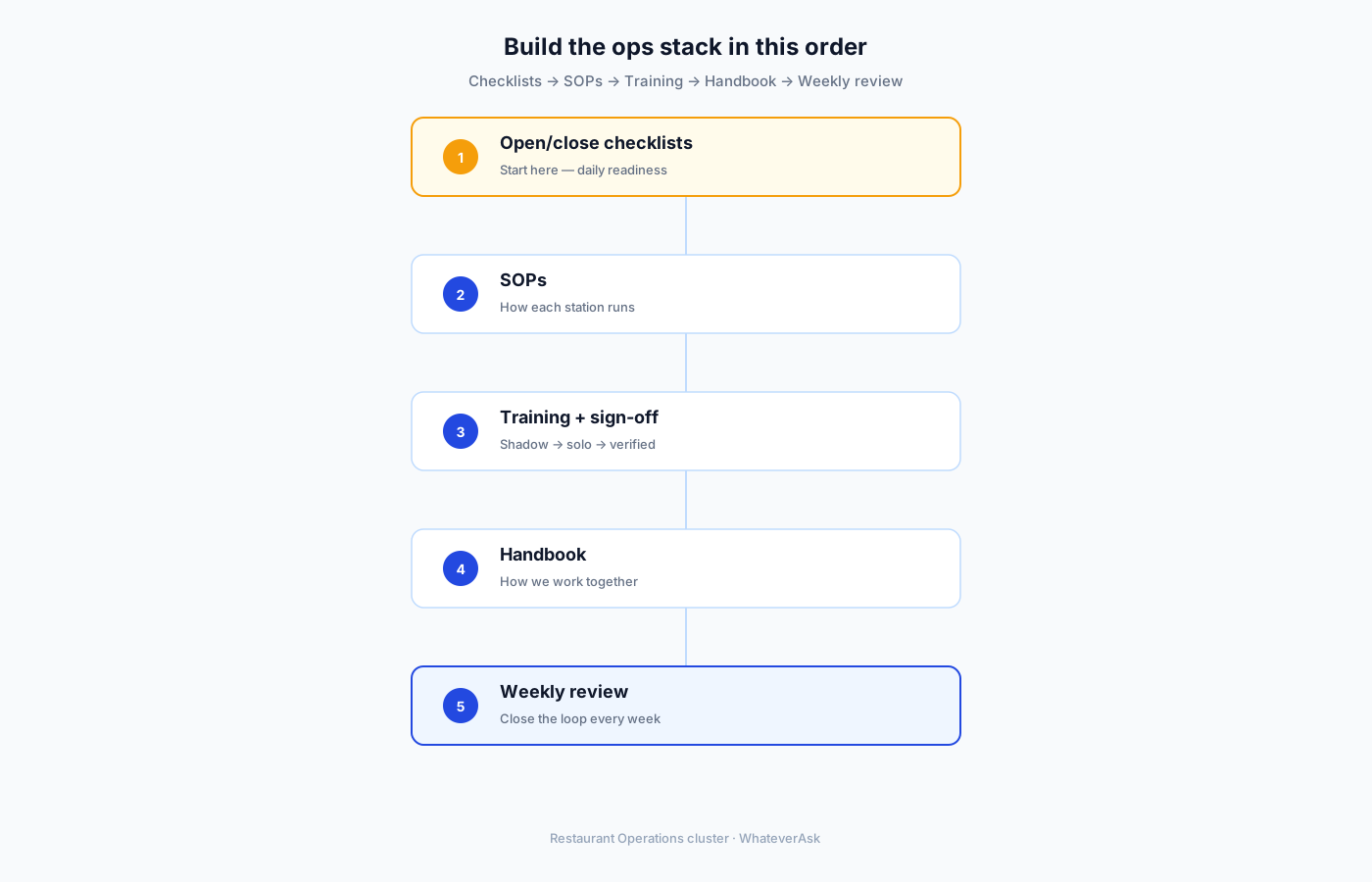
- Written procedures, training, and handbooks matter. Dedicated guides for those systems are not live yet in this lane. Name the day anyway.
- AI and automation come after the rhythm. They are tools, not a substitute for an owned day.
Action checklist
- [ ] Write yesterday against the seven lanes. Mark which ones had no named owner.
- [ ] Put one name on Open and one name on Close for the next three shifts.
- [ ] Write a one-page open or close list. Inspect it once this week.
- [ ] Kill one informal service handoff (pocketed pad, shout-only ticket, memory pass).
- [ ] Run one mid-shift reset between rushes and write what “reset” means in your room.
- [ ] Read money the same day: drawer, voids, comps, paid-outs.
- [ ] Write waste once, even roughly. Pair it with the money read.
- [ ] When leads change, hand over 86, open guest issues, money state, and one warning.
- [ ] Read Why Kitchen Tickets Still Get Lost if the pain is speed, or the order-accuracy page if the pain is wrong plates.
- [ ] Do not buy an “AI restaurant” tool until the day is named. Use the AI prerequisite page once it is live.
Continue learning
- Restaurant Operations hub: parent lane. This page is the first daily-ops child. More guides in this lane are not live yet.
- Restaurants: operations, growth, and AI lanes.
- The Operator Journey: founder arc: opening fear to systems thinking (EXP-011).
- We Almost Never Sent a Wrong Order: human story behind accuracy discipline (EXP-008).
- Restaurant Operator Journal: living-lab cases from running the room.
- *The Week the Floor and the Numbers Stopped Matching* — journal companion (Package 2; add live link only after publish).
- Why Kitchen Tickets Still Get Lost: service-speed / Kitchen Information Chain.
- How AI and Automation Prevent Wrong Restaurant Orders: Order Integrity Chain.
- AI for Restaurant Owners: AI cluster. Read the daily rhythm first.
- *Don’t Automate a Restaurant With No Daily Operating Rhythm* — AI prerequisite (Package 3; add live link only after publish).
- Guides: structured paths. Treat operations-lane children as live only when they 200.
Frequently asked questions
What are daily restaurant operations?
They are the repeating work that must happen today so the restaurant can serve honestly tonight and start clean tomorrow. In this page that work is seven lanes: open, prep, service, close, money, people, and food. If a lane has no named owner on the schedule, it is not an operation yet. It is a hope.
What is the difference between restaurant operations and day to day restaurant operations?
“Restaurant operations” is often used as a stack: procedures, training, handbooks, checklists, weekly review. Day to day restaurant operations are the rhythm inside that stack: what actually happens on this shift. You can have documents and still have a chaotic Tuesday. You can also name the day before every document exists. This page is the day.
What should an owner or GM do every day?
See the seven lanes finish, or know who will. You do not have to perform every lane. You do have to make sure Open happened, Prep matches the day you will have, Service is working from a shared ticket, Close will reset tomorrow, Money gets a same-day read, People coverage is true, and Food has a stop at the pass. If you are doing all seven yourself, that is the first problem to name.
How do I run daily operations if I do not have SOPs yet?
Name owners and finishes first. A one-page open list, a shared ticket path, a close note, and a same-day drawer count are already daily operations. Written procedures, training paths, and handbooks make those finishes teachable. Dedicated guides for those systems are not live yet in this operations lane. Do not wait for them to start naming today’s work, and do not pretend a future template pack is available here.
What is a Daily Operating Rhythm?
It is the named framework on this page: seven lanes that must move every operating day. Audit which lane is still informal. That is usually the real cause of the “crazy day,” not a lack of hustle.
How is this different from a checklist?
A checklist confirms that items happened. The Daily Operating Rhythm tells you which kinds of work must exist, who owns them, and how they fail. You will still want short lists for open and close. The rhythm is the map those lists sit inside.
Why do busy days still feel unprofitable?
Because Service can look healthy while Money, Food, and People are informal. Covers and compliments are not the same as contribution, waste, and labor. Read the journal companion on the week the floor and the numbers stopped matching once it is live.
Do I need software to run daily restaurant operations?
No. A named opener, a prep list tied to the walk-in, a shared ticket, a close note, and a same-day money read will outperform an unused platform. Tools help when the rhythm already exists. They do not create it.
Is this page about AI for restaurants?
No. This is the operations-lane pillar for the daily rhythm. AI is a later tool. If you are being sold automation while the day is still unnamed, read the AI prerequisite once it is live, and stay on this page until the seven lanes have names.
Is NeuroPOS required?
No. NeuroPOS is a case tool in some of our operating stories. The reusable lesson is the Daily Operating Rhythm. Any team can name the seven lanes on the system they already have.