
Why Kitchen Tickets Still Get Lost — And How Shared Kitchen Information Protects Service Speed
Missed, delayed, and stacked kitchen tickets slow service more than wrong items. A Kitchen Information Chain shows how shared ticket flow protects speed — from a real Jeju operating case.
- Published
- 2026-08-12
- Last Updated
- 2026-08-12
Disclosure
This article is based on firsthand operating experience from Jeju Snow Salmon, a restaurant operated by the team building WhateverAsk. It is an operating case study for other restaurant owners — not a product pitch. Observations about ticket flow and service pace are owner / operator observations, not audited timing studies or invented percentages. NeuroPOS appears only as the tool used in the case; the reusable lesson is the kitchen information workflow.
Critical reading rule: sections marked What exists today describe structured kitchen ticket flow already in use. Sections marked AI opportunity next describe proposed future capabilities — not features claimed as live in NeuroPOS today.
This page is not a retell of wrong-order accuracy. For wrong items, modifiers, and remakes, see How AI & Automation Prevent Wrong Restaurant Orders and the Founder's Journal companion We Almost Never Sent a Wrong Order. Here the problem is different: tickets that are correct but late, buried, or never seen.
Quick Answer
A kitchen can cook the right dish and still lose the shift — if the ticket arrives late, stacks unread, or vanishes into a verbal call-out nobody owns.
Service speed is not only cook skill. It is whether every station works from the same shared kitchen information at the same moment. Missed tickets, delayed tickets, and stacked tickets create the same guest experience: waiting, apologies, and a dining room that feels slower than the menu promised — even when nothing was “wrong” on the plate.
In our restaurant, Jeju Snow Salmon, adopting a standardized digital ticket path supported by NeuroPOS did not make cooks magically faster. It made ticket visibility and ownership harder to lose under pressure, because the kitchen no longer depended on one person remembering to shout the next order or dig a slip out of a pile.
This article separates two layers clearly:
- What exists today — Capture → shared kitchen display / ticket → cook against one record → pass check.
- What AI could enable next — load balancing hints, stuck-ticket alerts, and station-load signals on top of that shared record.
Named framework: the Kitchen Information Chain. If your line is slow for “no obvious reason,” audit this chain before blaming the menu or hiring another cook.
Why Service Speed Dies When Tickets Get Lost
Independent owners usually diagnose slow service as a people or skill problem: not enough cooks, uneven plating, weak expediting. Those can be real. But a quieter failure mode shows up first in many independents — including the planning conversations we had before Jeju Snow Salmon opened:
- The ticket was correct.
- The food would have been correct.
- Nobody cooked it on time because the information did not arrive, stay visible, or stay owned.
That failure looks like:
| Failure mode | What the guest feels | What the kitchen sees |
|---|---|---|
| Missed ticket | Empty table waiting; “did they forget us?” | An order that never hit the line, or hit the wrong station |
| Delayed ticket | Courses out of sync; drinks empty; check-backs awkward | A ticket that sat in a pad, a chat, or a printer queue while the dining room moved on |
| Stacked ticket | Long gaps, then a flood of plates | A pile of slips / a crowded screen with no clear “next” |
Wrong-item remakes are painful and visible. Lost or delayed tickets are quieter and often more expensive across a full shift: they stretch every table after the first delay, force defensive double-checks, and teach the dining room to apologize in advance.
What this article is not
This is not the accuracy problem (wrong modifier, wrong item, wrong table match). Accuracy is covered in the order-accuracy companion. Here the ticket can be perfect and the shift still collapses — because speed depends on shared, timely kitchen information, not only on correct fields.
The Traditional Ticket Path — And Where Speed Breaks
Most independents inherit a familiar path because it needs no training day:
- Capture — server writes or taps an order.
- Relay — someone walks a slip, shouts a call-out, or hopes the printer fires where the right station hears it.
- Pile — tickets land in a stack, on a rail, or in a verbal queue ordered by whoever shouted last.
- Interpret under noise — cooks decide “what’s next” from memory, peer pressure, or whoever is loudest.
- Pass scramble — the expeditor reconstructs table timing from incomplete signals.
This can work when volume is low and the same two people run every station. It breaks when covers rise, stations specialize, or the dining room sells faster than the verbal channel can clear.
The core weakness is not effort. It is unowned information:
- A ticket that only one person “heard” is not a kitchen system.
- A stack without a shared “next” rule is a lottery.
- A delayed printer or a pocketed pad creates invisible queue debt the guest already feels.
The hidden cost of missed, delayed, and stacked tickets
| Cost type | Visible | Hidden |
|---|---|---|
| Guest wait | One apology | Tables after that one also slow; trust erodes for the whole room |
| Labor | One rush plate | Line rhythm breaks; cooks idle then flood; overtime becomes habitual |
| Food quality | One “fire faster” | Holding, remakes from cold food, uneven plating under panic |
| Staff trust | One “where’s that ticket?” | Chronic suspicion that the system is unreliable — defensive slowdown |
| Revenue | Rare walkout | Soft loss: fewer turns, shorter stays, weaker repeat intent |
Owners who only track remakes miss this. Ticket-flow failures often show up as “we were just busy,” not as a named metric.
What Exists Today: Shared Kitchen Ticket Flow
When we opened Jeju Snow Salmon, we planned for order accuracy and for kitchen visibility as related but separate problems. Accuracy asks: is the record correct? Ticket flow asks: is the correct record seen, sequenced, and owned by the line in time?
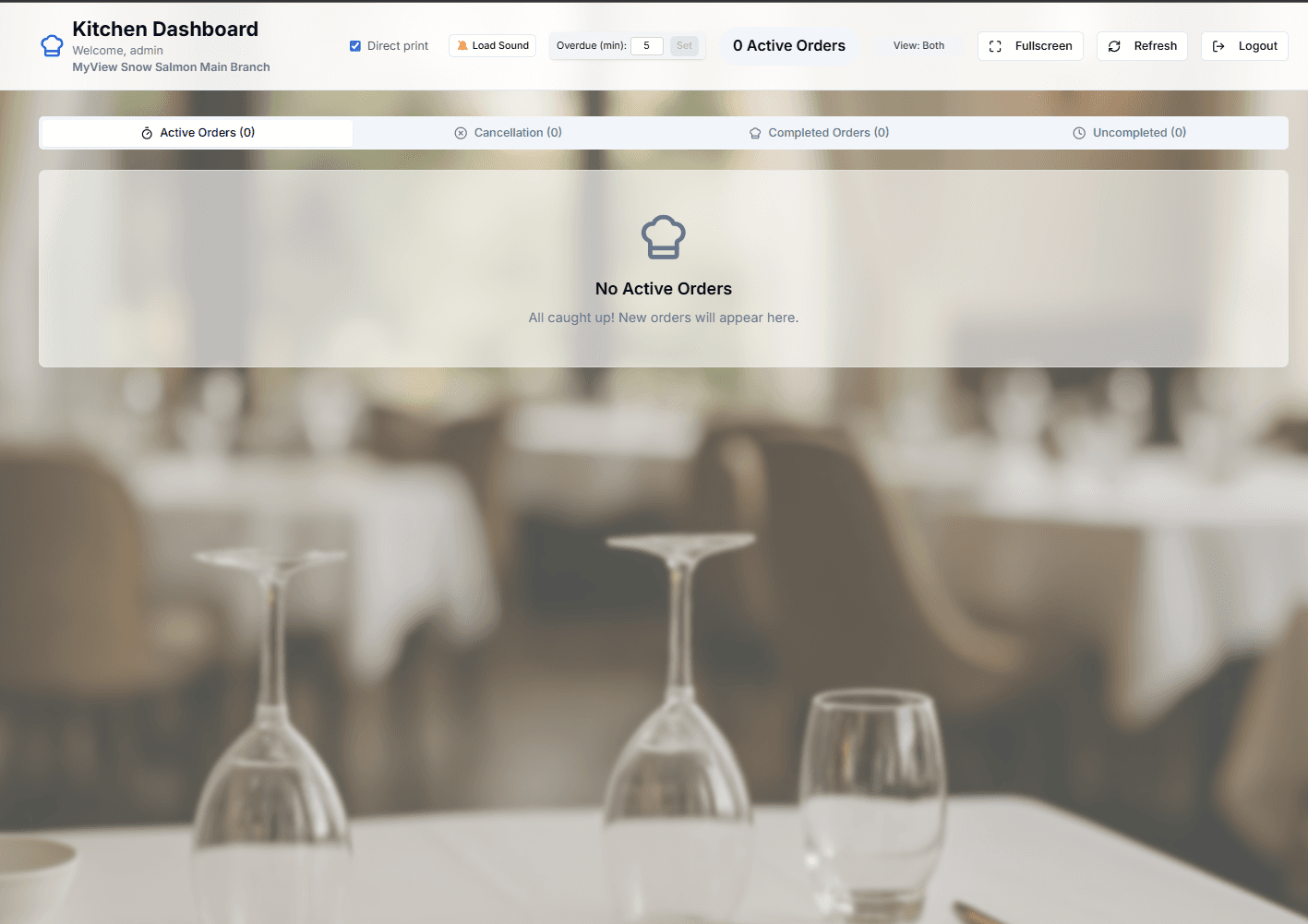
We run a standardized digital ticket path supported by NeuroPOS. In owner observation, missed and buried tickets became rare enough to investigate individually rather than treat as normal rush noise — not because software is magic, but because the workflow removes the informal places tickets used to disappear.
This section is what exists today. It is structured kitchen information flow. It is not a claim that NeuroPOS currently runs AI load-balancing (that comes later as opportunity).
Practical shape:
Guest order → structured capture → shared kitchen ticket / display → cook against one record → pass check → service
1. Capture once — then stop re-creating the ticket
The order is entered once with structured items. The kitchen does not wait for a second handwritten recreation. Every recreation is a delay opportunity and a miss opportunity. Capture discipline is the start of speed, not only of accuracy.
2. Share the same ticket across the kitchen — do not relay it
Once captured, the ticket is visible on the kitchen path (display and/or controlled print) without requiring a person to remember to shout it. Stations that need the same order see the same record. Verbal relays remain useful for hospitality (“table eight is celebrating”) — they should not be the primary carrier of which ticket is live.
3. Cook against one record
Line cooks work from the shared ticket, not from a second-hand retelling. That sounds obvious. Under a rush it is the difference between a steady line and a line that keeps asking “what’s on this one?” — questions that cost seconds on every plate and minutes across a peak.
4. Pass check against the same record
The pass confirms readiness and table match against the same ticket the line cooked. Pass check here is about timing and completeness of the ticket set, not only “is the modifier right?” (accuracy). A shared record lets the expeditor see what is still open without reconstructing the dining room from memory.
5. Standardization protects speed when the team rotates
As more people rotate through stations, informal ticket ownership gets worse. A shared digital ticket path does the opposite: the next cook can pick up the same visible work without inheriting someone else’s private mental queue. That is how service pace stays steadier across shifts — owner observation from running with a real team, not a lab demo.
NeuroPOS is an operational case, not an advertisement. Most modern POS + kitchen display setups can approximate the same principle: one shared ticket, visible, owned, sequenced.
Where Tickets Still Get Lost (Even With Screens)
Digital tickets do not automatically fix service speed. Common failure modes we watch for — and that other owners report — include:
- Capture lag — the dining room sells faster than orders are entered; the kitchen is “slow” while tickets are still in a server’s pocket.
- Station filtering without ownership — a ticket shows, but nobody fires it because every station assumes another station owns it.
- Screen stacking without triage — a crowded display recreates the paper pile problem if there is no clear aging / bump discipline.
- Split tickets without a join rule — courses or modifiers split across views without a pass-level view of the whole table.
- Shortcut culture under pressure — staff revert to shout-outs “just for this rush,” which recreates the old miss pattern exactly when volume is highest.
The lesson: tools expose ticket flow; discipline makes it reliable. Shared information only protects speed if the team treats the shared record as the only live queue.
Original Framework: The Kitchen Information Chain
We name the pattern so owners can diagnose it without buying anything first. The Kitchen Information Chain has four checkpoints. Service speed holds only if all four hold:
| Checkpoint | Question it must answer | What breaks it | What protects it |
|---|---|---|---|
| 1. Capture | Was the order entered promptly into the system of record? | Pocketed pads, delayed entry, verbal-only “I’ll put it in later” | Immediate structured entry at the point of sale / table |
| 2. Share | Can every relevant station see the same live ticket? | Shout-only relays, one private slip, printer in the wrong place | Shared kitchen display / ticket path with station visibility |
| 3. Cook against one record | Is the line working from that shared ticket — not a retelling? | Second handwritten lists, “just make what I said” | Cooks reference the shared ticket; bump only when work is real |
| 4. Pass check | Does the pass confirm the table’s open tickets before food leaves? | Memory-based expediting; no view of aging tickets | Pass works from the same record; clears / sequences deliberately |
How this differs from the Order Integrity Chain
| Order Integrity Chain (accuracy companion) | Kitchen Information Chain (this page) | |
|---|---|---|
| Primary risk | Wrong item / modifier / table match | Missed, delayed, or stacked tickets |
| Guest pain | “This isn’t what I ordered” | “We’ve been waiting forever” |
| Core question | Is the record correct end-to-end? | Is the correct record seen and owned on time? |
| Typical metric | Remakes | Ticket age, course sync, apologies for wait |
Use both. Fixing accuracy without ticket visibility still leaves slow service. Fixing visibility without accuracy still remakes food. They are sibling systems — not synonyms.
AI Opportunity Next: Catching Stuck Tickets Before Guests Feel Them
Once kitchen tickets are structured and shared, a second layer becomes possible — intelligence on top of the queue, not instead of the queue.
This section is future opportunity / proposed capability. Do not read it as a claim that these AI functions already ship in NeuroPOS today.
Proposed future architecture
Shared ticket queue → aging / anomaly signals → station-load hints → manager alert → human decision → kitchen confirmation
Potential future AI capabilities (labelled as opportunities unless separately evidenced as live) may include:
- Stuck-ticket / aging alerts before the dining room complains
- Station-load imbalance hints during peak
- Unusual silence detection (a station with open tickets and no bumps)
- Course-timing risk flags for multi-course tables
- Repeated miss-pattern analysis across shifts (where tickets keep dying)
- Predictive “queue debt” warnings before a known peak window
The narrative remains:
Human problem → shared operational record → automation of visibility → intelligence on exceptions → better human outcome
not:
AI → makes the kitchen faster by itself.
AI is the tool. The ticket chain is the foundation. Intelligence only helps when the shared record already exists.
Operational Improvements We Observed
We do not publish exact ticket times or cover counts — those stay internal — but the qualitative pattern has been consistent:
- Missed tickets became unusual events we could investigate, not background noise of a busy night.
- Peak pace felt steadier because the line spent less time reconstructing “what’s next” from shout-outs.
- New station staff ramped faster on ticket ownership, because the queue was visible instead of tribal.
- Manager attention shifted from hunting lost slips to coaching timing and hospitality — a better use of limited floor focus.
Guests should not notice “a system.” They should notice food arriving in a rhythm that matches the room. That is the point of shared kitchen information.
Customer experience
When tickets stop getting lost, guests experience fewer unexplained waits and fewer “sorry, let me check the kitchen” loops. That confidence is quiet. It shows up as a room that feels under control — which is often what people mean when they say a restaurant “runs well,” even if they never see a screen.
Lessons Learned
- Speed dies in unowned information before it dies in slow hands. If nobody owns the next ticket, cook skill cannot rescue the table.
- Shared visibility is a discipline, not a screen feature. A KDS that nobody trusts becomes wallpaper; bump discipline and capture lag matter as much as hardware.
- Accuracy and ticket flow are siblings. Wrong-item fixes do not automatically fix missed tickets; diagnose with the right chain.
- Stacking is a process failure, not proof you need more cooks. A clearer “next” rule often recovers more pace than another body on a chaotic queue.
- AI comes after the shared record. Exception detection on a noisy verbal channel just creates smarter confusion.
Experience Library: EXP-009 — kitchen ticket flow / service speed (see package). Related: EXP-008 — order accuracy as a workflow problem.
Practical Playbook for Other Restaurant Owners
You do not need NeuroPOS specifically. Apply the Kitchen Information Chain on whatever system you have:
- Map ticket age for two peak services — when does the guest order become a kitchen-visible ticket?
- Kill one relay — remove one shout-only or pocketed-pad step between capture and the line.
- Name ownership — for each ticket type, which station fires first, and who bumps?
- Define stacking rules — what “next” means when five tickets arrive together (course, table, item priority).
- Give the pass the same live view the line uses — do not let expediting run on memory alone.
- Train capture lag as a speed metric — “enter before you walk away” is a service-speed SOP, not only an accuracy SOP.
- Separate metrics — track remakes (accuracy) and ticket-age / wait apologies (flow) as different conversations.
Founder Insight
Before we opened, I worried about wrong plates. I underestimated how much guest trust also depends on whether the kitchen ever sees the ticket in time. A correct dish that arrives after the table has gone quiet still feels like a miss.
Shared kitchen information did not make our team less human. It made the invisible queue visible — so humans could apply judgment to the real work instead of hunting for slips. NeuroPOS was the tool in our case. The decision any owner can copy is simpler: stop letting ticket ownership live in one person’s memory during a rush.
Strategic Meaning & Business Value
What does this actually mean for a restaurant operator?
Operational value. Missed and stacked tickets are queue failures. A Kitchen Information Chain turns “we were busy” into a diagnosable workflow: capture lag, share gaps, cook-from-retelling, or weak pass check. That diagnosis is actionable the same week — often without new headcount.
Customer value. Guests experience ticket-flow failures as waiting and uncertainty. Protecting shared, timely kitchen information protects the feeling that the restaurant is in control — a core reason people return even when they never complain out loud.
Financial / growth value. Lost tickets silently tax turns, labor rhythm, and food quality under panic. Recovering pace without chronic overtime is often higher-leverage than buying another acquisition channel. Growth that outruns ticket visibility creates more apologies, not more profit.
Strategic value. Restaurant automation earns trust when it removes ambiguity from real service moments. Shared kitchen tickets are a foundational automation layer on the journey from operations → optimization → automation → AI operations. AI alerts on stuck tickets only matter after the shared record exists. NeuroPOS in this case is evidence of that journey — not the product story.
Service speed is not a motivational poster in the kitchen. It is whether information arrives, stays shared, and stays owned — every ticket, every rush.
Key Lessons
- Missed, delayed, and stacked tickets are a kitchen information problem, not only a staffing problem.
- The Kitchen Information Chain (Capture → Share → Cook against one record → Pass check) is the diagnostic.
- Accuracy ≠ speed — link the accuracy companion for wrong items; use this page for ticket flow.
- Shared displays help only with ownership and bump discipline.
- AI opportunity next = stuck-ticket and load signals on top of a shared queue — not a substitute for the queue.
Action Checklist
- [ ] Time capture lag for one peak service (order spoken → ticket visible in kitchen).
- [ ] List every place a ticket can exist that is not the shared kitchen record (pads, chats, shout-only).
- [ ] Assign station ownership + bump rules for your top five ticket types.
- [ ] Give the pass the same live ticket view the line uses.
- [ ] Separate remake tracking (accuracy) from wait-apology / ticket-age tracking (flow).
- [ ] Read the order-accuracy companion if wrong items are also common — run both chains.
- [ ] Only after the shared record is trusted, consider future stuck-ticket alerts (AI opportunity) — do not buy “AI kitchen” claims that skip visibility.
Continue Learning
- How AI & Automation Prevent Wrong Restaurant Orders — sibling cornerstone: wrong items / Order Integrity Chain (accuracy, not ticket age).
- We Almost Never Sent a Wrong Order — Founder's Journal human story behind accuracy discipline.
- AI for Restaurant Operations Hub — cluster home for ops + AI evidence pages.
- Restaurant Operations hub — SOPs and floor systems that ticket flow depends on.
- How restaurant owners save time with AI — owner-admin time layer adjacent to kitchen systems.
- Restaurant Digital Transformation — phased systems context for POS + kitchen display.
AI Native Restaurant Insight
An AI-native restaurant is not one that posts about AI. It is one where repeatable service moments — including which ticket is live — stop depending on private memory. Shared kitchen information is unglamorous infrastructure. It is also the difference between a room that feels calm under load and a room that apologizes its way through every peak.
Build the Kitchen Information Chain first. Add intelligence only when the queue is already true.
Frequently Asked Questions
What causes kitchen tickets to get missed during a rush?
Most misses come from unowned information: delayed entry, shout-only relays, private slips, or a stack / screen with no clear next rule. The ticket may be correct and still never get cooked on time.
How is this different from wrong-order accuracy?
Accuracy is about whether the record matches what the guest asked for. This article is about whether the correct ticket is seen, sequenced, and owned in time. A kitchen can be accurate and still slow if tickets stack or vanish.
Do I need a kitchen display system (KDS) to fix this?
A KDS helps when it creates shared visibility + ownership. Paper can work at low volume. As stations and covers grow, a shared digital ticket path usually protects speed better than shout-outs — but only with bump discipline and fast capture.
Do I need NeuroPOS specifically?
No. NeuroPOS is the tool in our operating case. The reusable lesson is the Kitchen Information Chain. Most modern POS systems with kitchen display or controlled ticket printing can approximate the same shared-record pattern.
Will shared digital tickets slow my kitchen down?
In our experience, once the team trusted the shared queue, they spent less time reconstructing “what’s next,” which kept peak pace steadier. Chaos comes from hunting information, not from reading a clear ticket.
What should I measure if I suspect ticket-flow problems?
Separate remakes (accuracy) from ticket age and wait apologies (flow). Time how long it takes for a guest order to become kitchen-visible. Watch for stacking without triage during your busiest hour.
What is the Kitchen Information Chain?
Four checkpoints — Capture, Share, Cook against one record, Pass check — where service speed either holds or dies. Auditing which checkpoint is still informal is the fastest way to find why tickets get lost.
Is AI required to protect kitchen service speed?
No. Shared, timely kitchen information is the foundation and exists today as structured automation. AI stuck-ticket or load alerts are a future layer on top of that record — labelled as opportunity in this article, not as a live claim.
Is this article sponsored by NeuroPOS?
No. This is an operating case study from Jeju Snow Salmon, disclosed above. WhateverAsk owns editorial responsibility; the tool is discussed only to illustrate the kitchen information principle.