
After the First Visit: Turning Restaurant CRM into Better Rewards and More Relevant Sales
A restaurant can know yesterday’s sales and still not know which guest is likely to return. CRM, rewards and promotion only help when records, permission and delivery are kept separate.
- Published
- 2026-10-15
- Last Updated
- 2026-10-15
Why this matters
A restaurant may know how much it sold yesterday without knowing which guests are likely to return, or what would give them a good reason to do so.
That gap matters. Advertising can help attract a first visit. Customer relationship management, or CRM, helps a restaurant build on the relationship that follows.
At WhateverAsk, we are continuing to upgrade the customer-management, rewards and promotion workflows around NeuroPOS, the system used at our family-operated Jeju Snow Salmon restaurant in Doha.
The direction is practical: connect customer records and rewards with decisions that staff and owners can use.
Development status, 15 October 2026
NeuroPOS is used in daily service at Jeju Snow Salmon. The CRM and rewards upgrade is a separate piece of work, and the parts do not all have the same status.
| Work | Status on 15 October 2026 |
|---|---|
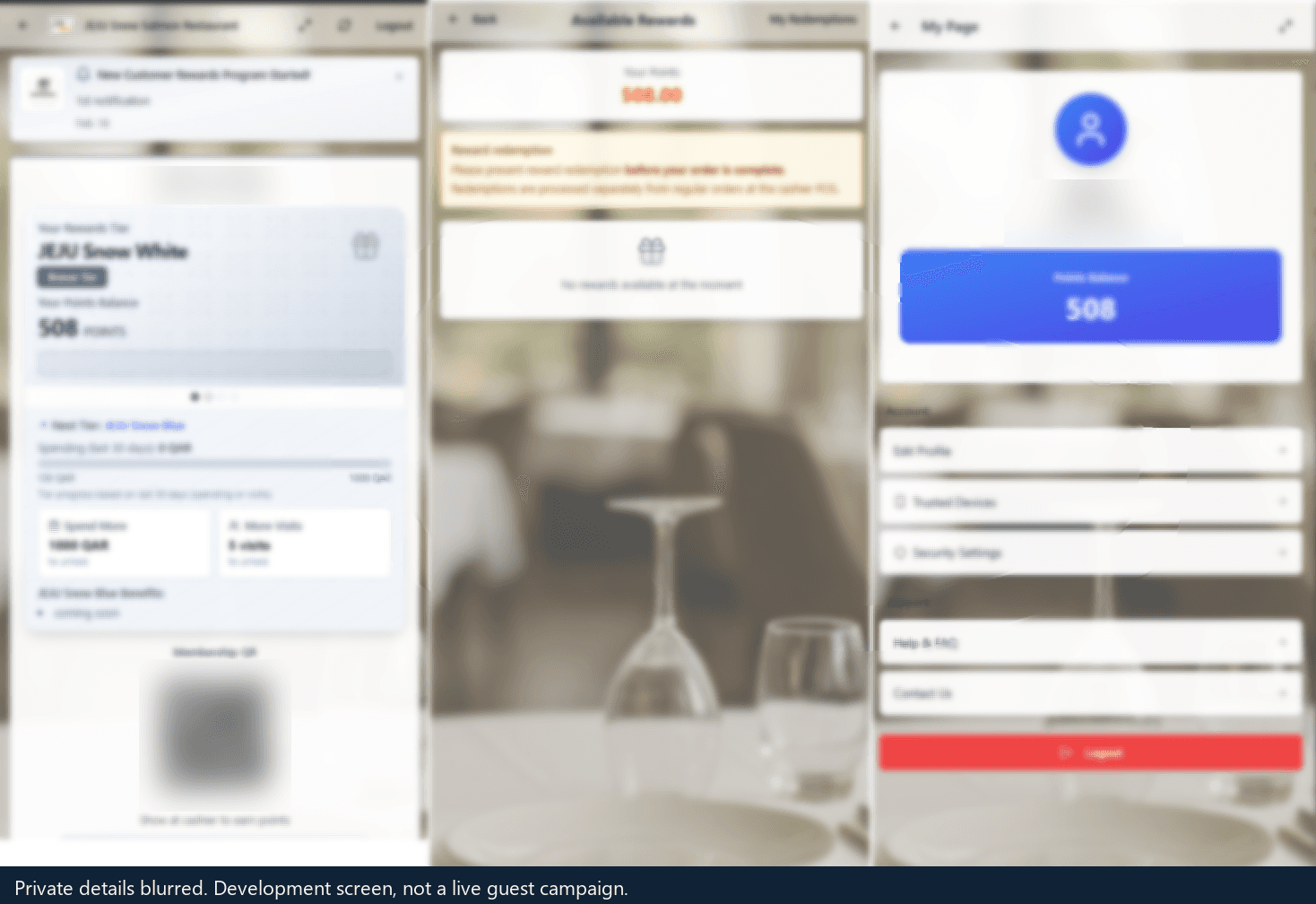
| Customer records | Development and AWS TEST. The published image is a rewards screen from that work. The customer name, phone number and membership code are blurred. The visible point balance matches a test ledger, so the image is development evidence, not a live guest campaign. |
| Rewards | Points, tiers and redemption screens are in development and AWS TEST. Live guest redemption at the restaurant has not been verified as a completed operating process. |
| Consent | Marketing permission is handled separately in the same development work. A phone number taken for a receipt or reservation is not permission to send a promotion. |
| Promotion preparation | Coupons and promotion events are development work. A broadcast to every customer was stopped. |
| Actual message delivery | Not verified as a completed live send to restaurant guests. An available screen or API is not the same as a message that reached a customer. |
The campaign examples later in this article stay illustrative. They are not a list of NeuroPOS features that are already sending messages.
Why CRM matters beyond a customer list
A name and phone number are only the beginning.
A useful restaurant CRM connects a customer with the information needed to serve them appropriately: their recorded visits, purchases, reward position and communication preferences, where those records are available.
That context can help an operator distinguish between different needs. A recent first-time guest may appreciate a reason to return. A regular customer may value recognition. Someone who has not visited for some time may respond to a relevant invitation.
Sending the same discount to all three misses those differences.
The National Restaurant Association’s April 2024 article on loyalty programs describes them as a way to understand preferences, personalize service and encourage repeat business. Square’s Customer Directory similarly illustrates how purchase history, loyalty status and customer groups can support more relevant engagement.
These are useful principles from other operators’ tools. They are not NeuroPOS results, and they are not a claim that Jeju already runs the same campaigns.
In Qatar, the Starbucks Rewards terms, effective May 2025, are a separate regional example: Stars are earned in participating stores, and promotional email is tied to an opt-in. That program’s Stars, tiers and offers belong to Starbucks and Alshaya. They are not features of NeuroPOS.
Where additional sales opportunities come from
CRM can support several different commercial opportunities.
A more relevant addition to an existing order. A guest interested in a main dish might welcome a suitable side or drink. This is cross-selling. A larger portion or premium alternative is an upsell. Both work best when the suggestion fits the meal and the guest’s needs.
A reason for another visit. A reward can give a satisfied guest a timely reason to return. Its usefulness depends on whether the guest understands it and whether staff can explain and redeem it consistently.
An introduction to something different. A regular customer may know one part of the menu well. A relevant invitation can help them discover another dish or dining occasion.
A thoughtful welcome back. Where visit records and marketing permission support it, a restaurant can test an invitation to customers who have become less active.
These are campaign possibilities, not a statement that every function is already available in NeuroPOS. Each needs reliable data, a clear purpose and an appropriate delivery process.
Rewards should protect the value of the sale
More redemptions do not automatically mean a better promotion.
Consider this hypothetical example: a guest adds a QAR 20 item because of an offer. If its variable cost is QAR 7 and the reward creates another QAR 5 of incremental cost, the addition contributes QAR 8 before other incremental expenses.
That calculation only helps if the purchase was genuinely additional. If the customer would have bought the item anyway, the promotion may simply have reduced the contribution from an existing sale.
Owners should therefore examine repeat visits, additional purchases, reward costs and contribution together. Campaign revenue alone does not answer whether the offer was worthwhile.
Why the NeuroPOS approach is useful
NeuroPOS gives us an operating environment in which customer-management and rewards workflows can be developed alongside the work of running a restaurant.
That connection matters. A promotion depends on more than its message. Staff must find the correct customer, understand the reward, apply the right conditions and handle exceptions.
Our current upgrade work focuses on strengthening that connection between customer records, rewards management and controlled promotional activity. Individual capabilities must be distinguished by their actual status: operating, under test or planned.
The aim is a process the restaurant can use consistently, with a clear record of what happened.
Because NeuroPOS is used at Jeju, development questions can be examined against actual operating needs. This is an owner-family implementation example. We are not presenting an independently measured client result or promising a revenue increase.
Where AI can help
AI can assist with examining customer patterns, preparing campaign options and drafting messages when the necessary data and approved tools are available.
The restaurant still needs to decide whether the offer is appropriate, affordable and welcome.
Collecting a phone number for a receipt or reservation should not be treated as permission to send promotions. Communication preferences and opt-outs need to be respected, and messages should be reviewed before sending.
Developing software with AI assistance also does not mean every CRM function contains AI. The value comes from a well-designed workflow and appropriate use of the tools.
Start with one customer objective
A useful first project might focus on encouraging a second visit, improving reward redemption or testing one relevant menu addition.
Choose the objective, establish the starting position, define the offer and review what changes.
That is the AX, AI Transformation, approach we are developing through WhateverAsk: connect business information with practical action, then assess the value in operation.
Explore our implementations and services at whateverask.com. If your restaurant has customer records but no clear follow-up process, tell us what you would like the next customer interaction to achieve.
The image at the top is a NeuroPOS customer rewards screen from development work. The customer name, phone number and membership code are blurred. It is not a live guest campaign, and it does not show that a promotion was sent.
Frequently Asked Questions
Does a rewards screen mean NeuroPOS is already sending promotions?
No. A screen, a test account or an API can exist while message delivery is still unverified. On 15 October 2026, promotional delivery to restaurant guests had not been verified as a completed live send.
Is the QAR 20 example a Jeju result?
No. It is a hypothetical contribution check. It is not a measured sale, a redemption count or a forecast.
Are the National Restaurant Association, Square or Starbucks results NeuroPOS results?
No. Those sources describe their own programs and products. They are cited as outside context, not as evidence of what Jeju or NeuroPOS has achieved.