Restaurant Staff Training: Onboarding That Sticks
Build a restaurant staff training system that reduces turnover and mistakes — onboarding paths, station training, shadow shifts, and how to train to your SOPs.
- Published
- 2026-05-29
- Last Updated
- 2026-05-29
Executive Summary
Effective restaurant staff training is a system, not a vibe:
- Role map (what success looks like in each job)
- Handbook acknowledgment (employee handbook)
- SOP-based station training (restaurant SOP guide)
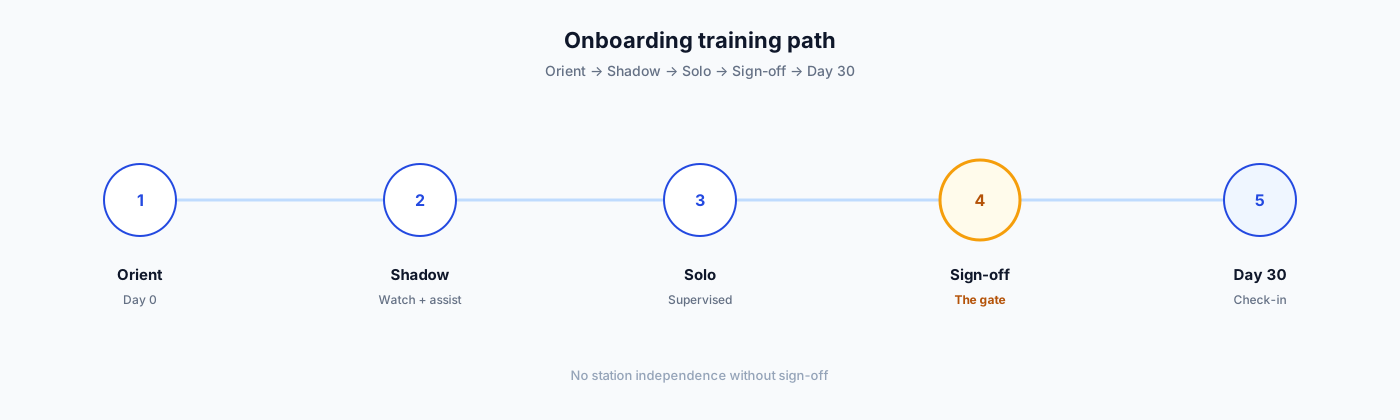
- Shadow shifts → supervised solo → station sign-off
- 30-day check-in and refreshers after menu/process changes
If training is “watch the senior person for two days,” you are cloning habits — including bad ones — and you will retrain forever.
⚠️ Local rules vary. Food-handler certifications, alcohol service training, and labor rules differ by jurisdiction. Confirm required certifications locally.
Introduction
“Watch Maria for two days” creates inconsistent restaurants. Maria may be excellent — and still teach shortcuts that break when volume spikes or when Maria leaves.
This guide builds a restaurant employee training path that sticks: orientation, station checklists, shadowing, sign-off, and refreshers. It assumes you either have SOPs or will write them in parallel. Training without standards is theater.
See the full ops map in restaurant operations.
Why This Matters
A real training program reduces:
| Pain | How training helps |
|---|---|
| Turnover cost | Clear paths and early wins reduce early exits |
| Guest complaints | Standards are taught the same way every time |
| Food-safety risk | Critical steps are quizzed and signed off |
| Manager burnout | Fewer “how do I…?” interruptions mid-rush |
| Inconsistent service | New hires match the house standard, not a random trainer |
Undocumented onboarding also hides weak hiring. If you cannot explain the job in a checklist, you cannot hire for it.
Step-by-Step Guide: Onboarding Path
Day 0 — Orientation (before floor work)
- Welcome, tour, emergency exits, first-aid / fire basics
- Handbook review and written acknowledgment
- Pay, tips (if applicable), scheduling, call-out process overview
- Food-safety and allergen non-negotiables (high level)
- Introduce trainer and first station goal
Keep Day 0 short. Overwhelm creates dropouts.
Days 1–3 — Station SOP training + shadow
- Train to the written SOP, not to memory
- Demonstrate → trainee explains back → trainee performs with coach
- Shadow during live service with a clear observation checklist
- Quiz critical safety items (handwashing, temps, allergens)
Days 4–7 — Supervised solo
- Trainee runs the station with a trainer in earshot
- Coach corrects in the moment; log gaps against the SOP
- No sign-off until the checklist is complete
Sign-off
Station sign-off means a named trainer confirms the trainee can perform the SOP to standard without continuous coaching. Until then, they are not “fully trained” — even if they have worked several shifts.
Day 30 — Check-in
Review: attendance, guest feedback, speed/accuracy, attitude, and remaining stations. Schedule next station or a refresher.
Refreshers
Retrain after menu changes, layout changes, or repeated mistakes. Do not wait for annual “training day.”
---
Practical asset — Role training checklists (generalized)
Use one checklist per role. Mark date + trainer initials.
Host / Hostess
| Skill | Trained | Shadow | Solo | Sign-off |
|---|---|---|---|---|
| Greeting & waitlist / reservations | ☐ | ☐ | ☐ | ☐ |
| Seating balance & section awareness | ☐ | ☐ | ☐ | ☐ |
| Allergy / special-need notes to FOH | ☐ | ☐ | ☐ | ☐ |
| Phone / to-go basics (if applicable) | ☐ | ☐ | ☐ | ☐ |
| Opening / closing FOH checklist items | ☐ | ☐ | ☐ | ☐ |
Server
| Skill | Trained | Shadow | Solo | Sign-off |
|---|---|---|---|---|
| Menu knowledge & 86 process | ☐ | ☐ | ☐ | ☐ |
| Order entry & modifiers | ☐ | ☐ | ☐ | ☐ |
| Timing / course firing | ☐ | ☐ | ☐ | ☐ |
| Allergy protocol | ☐ | ☐ | ☐ | ☐ |
| Payment / tip handling per house rules | ☐ | ☐ | ☐ | ☐ |
| Complaint recovery SOP | ☐ | ☐ | ☐ | ☐ |
Line cook
| Skill | Trained | Shadow | Solo | Sign-off |
|---|---|---|---|---|
| Station setup & mise | ☐ | ☐ | ☐ | ☐ |
| Ticket reading / ticket flow | ☐ | ☐ | ☐ | ☐ |
| Critical recipe builds (list top items) | ☐ | ☐ | ☐ | ☐ |
| Temp / food-safety checks for station | ☐ | ☐ | ☐ | ☐ |
| Cleaning & closing station SOP | ☐ | ☐ | ☐ | ☐ |
Prep
| Skill | Trained | Shadow | Solo | Sign-off |
|---|---|---|---|---|
| Recipe cards & yields | ☐ | ☐ | ☐ | ☐ |
| Labeling / dating / FIFO | ☐ | ☐ | ☐ | ☐ |
| Cooling / storage SOP | ☐ | ☐ | ☐ | ☐ |
| Knife / equipment safety | ☐ | ☐ | ☐ | ☐ |
| Prep list ownership | ☐ | ☐ | ☐ | ☐ |
Adapt names to your stations; keep the sign-off columns.
Framework: Day-0 to Day-30 Training Path
Train to documents, not vibes. Use a time-boxed path with explicit sign-offs.
| Phase | Timing | Outcome |
|---|---|---|
| Day 0 | First shift | House tour, safety/allergy non-negotiables, handbook acknowledgment, shadow assignment |
| Days 1–7 | First week | Station shadow → assisted work → first SOP sign-offs (open/close + role core) |
| Days 8–14 | Week two | Independent station work with spot checks; guest-recovery and ticket-flow sign-off |
| Days 15–30 | First month | Full role certification; cross-train one backup skill; 30-day check-in |
Sign-off rule: A trainer initials only when the trainee performs the SOP without prompting. “Watched once” is not certified.
Connect every module to a written SOP and the expectations in your employee handbook.
Best Practices
- One trainer per station during onboarding — mixed trainers create mixed standards.
- Train to the SOP first; personality and hospitality coaching second.
- Keep sessions short — 20–40 focused minutes beat a four-hour dump.
- Quiz safety — verbal teach-back on allergens and temps.
- Do not promote without trainer skills — your best cook is not automatically your best coach.
- Use the opening checklist in training so openers learn the daily ritual early (opening checklist).
- When short-staffed, shorten the menu or hours before you skip sign-off. Untrained solo work creates the mistakes that cost more than a temporary 86.
Sample first-week schedule (full-service server)
| Day | Focus | Outcome |
|---|---|---|
| 0 | Orientation + handbook ack | Cleared for floor training |
| 1 | Menu + POS modifiers + allergy protocol | Can enter clean tickets |
| 2 | Shadow lunch; timing notes | Sees real pace |
| 3 | Shadow dinner; complaint recovery SOP | Sees recovery done right |
| 4 | Supervised section (smaller) | Coach in earshot |
| 5–6 | Supervised section + feedback | Gaps logged against checklist |
| 7+ | Sign-off when checklist complete | Solo eligible |
Compress for QSR; expand for fine dining. The sequence matters more than the exact day count.
Retention link (without overclaiming)
Training will not eliminate turnover. It reduces preventable early exits caused by sink-or-swim onboarding and unclear standards. Pair training with fair scheduling and a readable handbook so people are not guessing the rules.
Common Mistakes
- Training before SOPs exist — you are training opinions.
- No sign-off — “they’ve been here a week” is not competence.
- Promoting without trainer skills — bad habits scale faster.
- FOH-only or BOH-only programs — cross-awareness prevents ticket wars.
- Never refreshing — menu changes without retraining guarantee variance.
- Handbook never acknowledged — expectations stay verbal and disputed.
Practical Examples
Example — New server path Day 0: floor map, allergen script, POS login, shadow dinner. Day 3: open sidework SOP signed. Day 7: full section with trainer as expo backup. Day 14: complaint-recovery SOP signed. Day 30: certified + one backup host skill.
Example — Line cook path Day 0: knife/safety, station diagram, temp logging. Day 2: mise SOP. Day 5: two recipe cards signed. Day 10: ticket-flow + expo handoff. Day 21: rush solo with chef spot-check. Day 30: certified on primary station.
Example — What “stuck” training looks like Trainee can recite steps but fails under rush. Fix: shorten the SOP, add a photo callout, and re-sign under peak conditions — do not add more classroom time.
Action Checklist
- [ ] Publish a one-page Day-0 → Day-30 path per major role
- [ ] Map each training module to a written SOP
- [ ] Require trainer initials only after unprompted performance
- [ ] Schedule a 30-day check-in on the calendar at hire
- [ ] Cross-train at least one backup skill per certified employee
- [ ] Retire “watch the senior” as the only method
- [ ] Align handbook acknowledgments with Day-0 paperwork
- [ ] Review first-90-day exits against common mistakes
Frequently Asked Questions
How long should restaurant onboarding take?
Enough to complete orientation, core station SOPs, shadow, supervised solo, and sign-off — often 1–2 weeks per primary station, longer for complex full-service roles. Rushing sign-off creates silent errors.
Should FOH and BOH share the same training program?
Share Day 0 (handbook, safety, culture). Split station SOPs. Add a short cross-exposure so each side understands ticket flow.
What is a station sign-off?
A documented confirmation that a trainee can perform the station SOP to standard without continuous coaching. It is the gate to unsupervised work.
How do I train when I’m short-staffed?
Protect critical safety and one primary station. Reduce volume (hours/menu) rather than skipping sign-off. Pair new hires with one named trainer only.
How often should I retrain existing staff?
After menu/process changes, after repeated errors, and on a light quarterly refresh for food safety and guest standards.
What’s the link between training and turnover?
Unclear expectations and sink-or-swim onboarding drive early exits. Structured paths do not eliminate turnover, but they reduce preventable early losses.
Do I need a training manager in a small restaurant?
No. You need a named trainer per station and checklists. Title optional; ownership mandatory.
Related Guides
- Restaurant Operations — Ops stack overview
- Restaurant SOP Guide — What you train to
- Employee Handbook for Restaurants — Expectations before floor work
- Restaurant Opening Checklist — Include open rituals in training
- Common Restaurant Mistakes — Hiring and training failure patterns
- How Restaurants Can Get More Customers — Train hosts/expo before scaling discovery
- Restaurant Knowledge Hub — Ops + Growth lanes
- About WhateverAsk — How we write operator-ready guides
Conclusion
Restaurant staff training sticks when it is SOP-based, signed off, and refreshed. Replace “watch the veteran” with role checklists, shadow shifts, and a 30-day check-in. That is how onboarding becomes a system — and how your restaurant operations survive the next resignation.
Last Updated
2026-05-29. Educational guide for owners and managers. Not legal or employment advice. Confirm required food-handler and alcohol-service certifications with local authorities.